Documents
Mental Anti-Virus Card: a short list of the main fallacies to keep in your wallet or pocket.
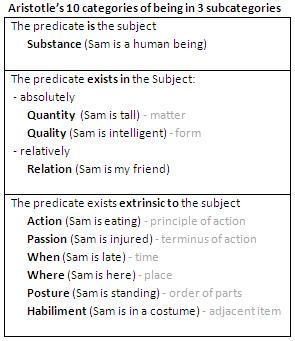
Aristotle’s 10 Categories Study Card
Topics coming to this site (in the meantime, all of the essentials are in the links above):
· Classical education
· The Seven Liberal Arts (the trivium + the quadrivium).
· The True Definition of Liberal (Demonizing the word liberal is the key to hiding all thought.)
· Pythagorean, right-angled triangle (534)
· Five senses: sight, hearing, touch, taste, and smell
· Letters: the philosopher’s stones
· Implicit vs. Explicit knowledge (it’s all in a name).
· Inductive (generalizing, building) vs. Deductive (start with what one knows)
· The Trivium: Grammar (Knowing), logic (understandng), rhetoric (wisdom) – the art of learning AND thinking.
· Grammar (Knowing): rule of definition or identification. The first step in a new exploration.
· Special grammar: the study of nouns, adjectives, verbs and all other forms of speech.
· General grammar: A study of the parts of speech – regardless of the language (research), the subject of a study. A method of organizing thoughts.
· logic (understanding) – possessing a critical mass of data with all contradictions removed (the elimination of contradiction).
· rhetoric (wisdom)
· Sentences – the foundation of a complete thought.
· Plato’s allegory of the cave
· Paradox – The law of duality
· Modes of thought: 1) mythopoeic, 2) philosophic, 3) scientific
· Burden of proof – fallacy from ignorance.
· Pedagogy: Dialectic vs. didactic/mimetic.
· Dialectics: internal dialectic, positive and negative (conversation)
· Dialectic teaching: the Socratic method
· Didactic: parrot teacher or text book. Use up to age 11.
· Phonics
· The School House
· Prussian Education
· Philosophy
· Does the Trivium or “classical education” belong to Christianity or any other religion?
· Who Developed the Trivium?
· Aristotle – 10 categories from which you can form a subject and predicate.
· The Trivium’s foundation in pagan origins
· Sophism: 2 branches (Isocrates vs. Demosthenes).
· Demosthenes: 322 (Skull & Bones)
· Hegelian dialectic: Problem, reaction, solution (thesis, antithesis = synthesis) both sides of politics, a contradiction, only possible in politics, not reality.
· Logical fallacies – formal and informal
· Syllogisms – A deductive argument consisting only of categorical constituents. Aristotle’s discovery. (5 rules of validity)
· Quantity and quality
· Copula – the linking verb.
· Distribution
· Immediate inference – more than one premise. (minimum 3: Obversion, Conversion, Contraposition)
· The Sophists – Who’s attempting to make the trivium method “trivial”?
· Sophists – Why it’s not cool to be “sophisticated” any more.
· The Trivium Meme – One Mind at a Time.
· The Trivium – Can critical thinking save humanity? It may be our only chance.
· Quadrivium
· Golden proportion